
10 Steps to Fall-Proof Your Parent’s Home
Falls are one of the most common reasons older adults lose confidence at home—especially when balance, vision, strength, or reaction time change. The good news: many fall risks come from small, fixable details in everyday spaces.
Use the checklist below to make the home safer without making it feel “clinical.”
1) Start with clear walkways
Create a clear path through the most used areas: bedroom → bathroom → kitchen → living room.
Remove small tables, plant stands, and décor that sit in the middle of the flow.
Quick win: If someone has to “sidestep” around furniture, the pathway is too tight.
2) Remove loose rugs (or secure them properly)
Throw rugs are a top trip hazard—especially on tile, hardwood, or laminate.
Either remove them or secure them with a full-coverage non-slip underlay.
Quick win: Avoid curled corners and thin mats that slide underfoot.
3) Improve lighting—especially at night
Add bright, even lighting in hallways, stairs, and entrances.
Use warm, glare-controlled bulbs and make sure switches are easy to reach.
Quick win: Install motion-sensor night lights from bedroom to bathroom.
4) Make stairs safer (and easier to read)
Stairs should have solid handrails on at least one side (ideally both).
Check that steps are evenly lit and that the edge of each step is visible.
Quick win: Add high-contrast stair edging or anti-slip stair treads.
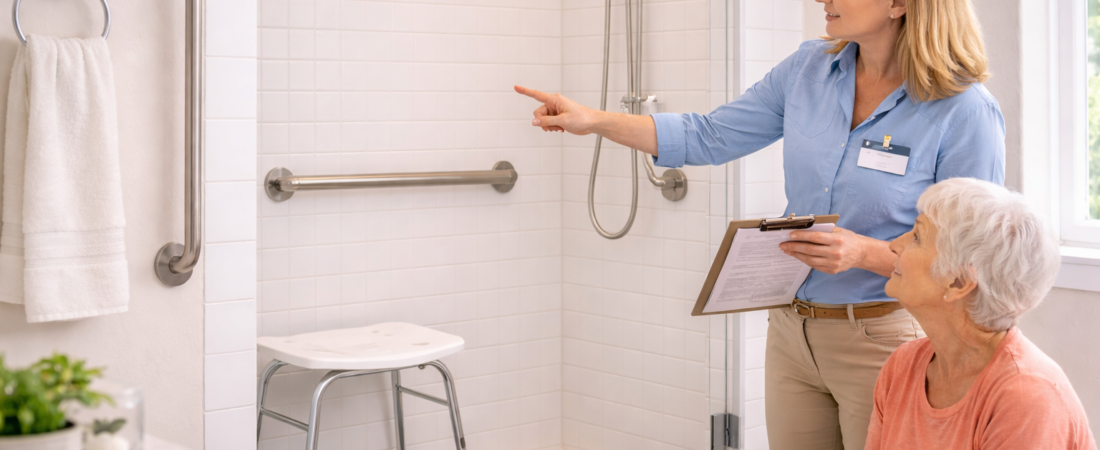
5) Upgrade the bathroom first
Bathrooms combine water + hard surfaces + turning movements.
Install grab bars where they’re actually needed: near the toilet and in the shower/tub.
Quick win: Use a non-slip bath mat and consider a shower chair for stability.
6) Reduce clutter “hot spots”
Most falls don’t happen in empty rooms—they happen where daily life piles up:
near the front door, beside the bed, around the sofa, or by the kitchen counter.
Quick win: Create a dedicated “drop zone” for bags, shoes, and mail.
7) Fix flooring transitions and thresholds
Small height changes between rooms can catch a toe or a walker.
Check door thresholds, uneven tile, loose boards, and lifted carpet edges.
Quick win: Use low-profile transition strips and secure any loose flooring.
8) Make seating safer (not too low, not too soft)
Low sofas and deep chairs make standing harder and increase imbalance.
Aim for firm seating with armrests so pushing up is stable.
Quick win: Add a firm cushion or furniture risers if the chair is too low.
9) Reorganize storage to reduce reaching
High shelves and low cabinets create risky bending and climbing.
Bring everyday items to waist height.
Quick win: Move the most used kitchen items to the easiest-to-reach shelf.
10) Watch for vision + contrast issues
When contrast is low (white walls, pale floors, glare), people misjudge distances.
Improve contrast at critical points: stair edges, bathroom fixtures, doorway transitions.
Quick win: Reduce glare from shiny floors and strong overhead lights.
Want a professional safety plan (with priorities)?
If you’re not sure what to tackle first—or you want recommendations that fit your parent’s needs and the home layout—we can help.
Book a Safe Home Assessment to identify the highest risks, quick wins, and an action plan tailored to your home.